
Magazine
Friends In Deed
Elizabeth Chandler and Dr. Nathan Thomas were two Quakers who fought for the abolition of slavery through their words and actions at a time when many people in Michigan opposed slavery but far fewer took a stand.
By Katie Vloet
The letter from Elizabeth Margaret Chandler to her Aunt Jane covered a lot of ground: her brother’s oat crop and young apple trees, new boundaries in the small Michigan town where she lived, the weather, and the abolition of slavery.
It was 1834. Elizabeth Chandler was 27 years old, a Quaker, and an abolitionist. In this letter, housed in a collection of Chandler’s papers at the Bentley Historical Library, she told her aunt, “Anti-slavery principles are gaining ground. Daniel Smith . . . mentioned the subject in his sermon, and spoke upon it for some time.”
Even as she went about her tasks of daily life, slavery was never far from her mind or her pen. Her collection at the Bentley includes letters to relatives and articles for the newspaper The Genius of Universal Emancipation in which she advocated for more women to join the anti-slavery cause.
The collection of Dr. Nathan Thomas tells the story of another Quaker in Michigan who supported abolition. Thomas’s home in the southwest Michigan village of Schoolcraft was a stop on the Underground Railroad, and accounts written by him and family members relay the often harrowing journeys of enslaved people who stayed at their home on their way to Canada or other parts of Michigan.
Together, the Chandler and Thomas collections illustrate the power that individuals and families possessed when they chose to push back against practices they thought were unjust. While historical accounts suggest that many or possibly most residents of the state were against slavery in principle in the early- to mid-1800s, Chandler and Thomas went far beyond principle; they took action.
A Poet, Editor, and Organizer
Chandler made a name for herself when she was just 18 and her antislavery poem, “The Slave Ship,” won third prize in the Casket monthly journal. Chandler was one of the first female poets to focus on antislavery, and her work caught the eye of abolitionist Benjamin Lundy, who asked her to write for his periodical, The Genius of Universal Emancipation.
She contributed to and edited the “Ladies’ Repository” section of the paper and advocated for pacifism, better treatment of Native Americans, and the immediate—not gradual—emancipation of enslaved people. In particular, she implored women reading her words not to fool themselves that enslaved people were happy with their circumstances, as many people opted to believe at the time.
“Many of you have been educated to believe this system natural and right— or if not right, at least a necessary evil,” she wrote. “You observe the dark countenances of the [enslaved people] lighted up with smiles; you hear the sounds of merriment proceeding from their cabins; and you therefore conclude that they cannot be otherwise than happy; as if the bitterest things of earth never wore a veil of brightness, or the mask of gaiety never served to conceal a bursting heart!”
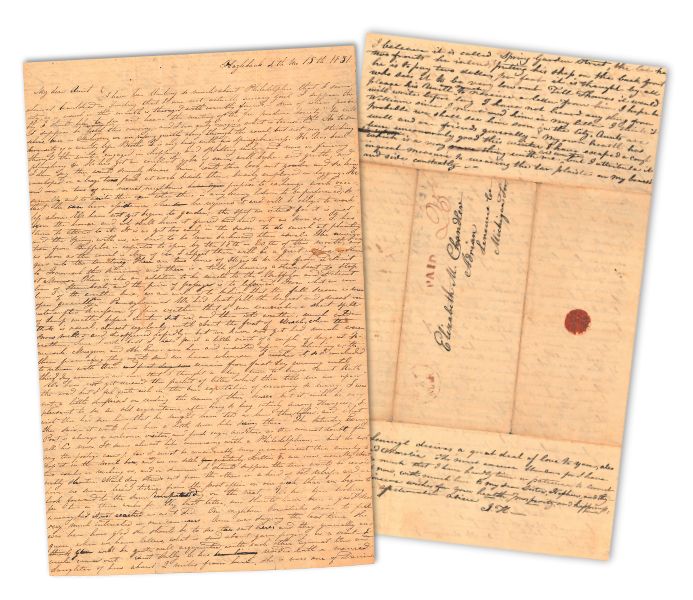
Letters from the Elizabeth Chandler collection.
As a woman—and an unmarried one at that—Chandler at times opted not to be completely open about her identity when writing about controversial topics. She sometimes wrote anonymously or signed her middle name, Margaret, or her first initial “E” to her work.
In 1830, Chandler moved from Pennsylvania with an aunt and brother to a farm near Tecumseh, Michigan. Here, she coorganized meetings with her friend Laura Haviland that eventually became the Logan Female Anti-Slavery Society, Michigan’s first antislavery association.
Chandler was just 26 when she caught a fever that took her life in 1834. The following year, her former colleague and publisher Benjamin Lundy wrote to Chandler’s brother in a letter that is housed in her collection at the Bentley. He wrote that he wanted to publish Chandler’s poems and articles in book form, which he would go on to do. The two volumes were widely circulated in abolitionist circles.
“(I)t will afford me the greatest pleasure to assist you in this matter. I shall never be able to fully discharge the obligation which I am under to the family for the inestimably valuable labors of our dear departed sister in conducting my periodical work,” Lundy wrote to Thomas Chandler.
“Never shall we look upon her like again.”
A Station on the Underground Railroad
About 100 miles west of Chandler’s home, physician Nathan Thomas and his family lived in the small town of Schoolcraft, Michigan. In his papers at the Bentley, he recounts one of the occasions when a former enslaved person stayed at his house.
“Lewis Hill came directed to me; he arrived at Schoolcraft in the evening after having taken supper with a kind friend near this place. He spent the night in my office; I advised him to go no further, as I thought he could safely remain here. But he expressed a determination, not to stop short of Canada,” Thomas wrote. “I added to his purse and gave him a line to some friends of the fugitives, and sent him on his way rejoicing.”
Later, he learned that Hill spent the winter with “old father Gillet of Washtenaw Co. and the following spring went to Canada, where under the protection of British Law, he became a freeman.”
Thomas—later a candidate for lieutenant governor—and his wife, Pamela, helped more than 1,000 enslaved people escape to freedom. The home where the enslaved people slept, often for just a single night, is listed on the National Register of Historic Places.
At least one of the men had handcuffs and chains still when he arrived at the Thomas home and needed a blacksmith to remove them. Many shared their stories with the family.
Pamela Thomas wrote, in a written recollection that is housed at the Bentley: “They came singly and by twos and threes. The first was a woman, advanced in years, who had made her way on foot, and alone, from Missouri . . . [who] told me of what some women had to endure from cruel, licentious masters. From that time I felt it was my duty to do what little I could for those attempting to escape from bondage.”
Pamela recounted that, when she visited relatives in Ann Arbor in 1844, her hostess told her, “I think it right and I’m glad to have them escape, but I could not take them into my home.”
Pamela, though, saw it differently. “I, an old lady of seventy-six years, feel glad and proud of my small share in the glorious emancipation.”